
Description
The goal of this interface is to retrieve the publish/purge task status.
Request
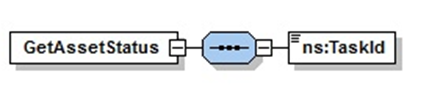
GetTaskStatus Xsd

Parameters
|
Name |
Type |
Description |
|---|---|---|
|
TaskId |
xs:string |
ID of the publishing job returned by “LoadAsset” method Or ID of the purge job returned by “PurgeAsset” method. |
Response
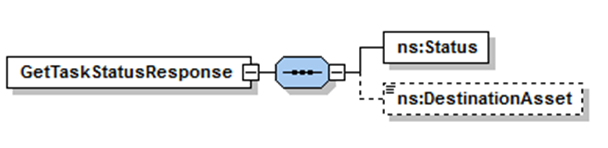
GetTaskStatusResponse Xsd

Parameters
|
Name |
Type |
Description |
|---|---|---|
|
Status |
xs:StatusType |
SUCCESS: The specified publishing job is completed.
|
|
DestinationAsset |
xs:string |
URI/Id of the destination repository from where the asset has been published.
Or the third-party may return an identifier as DestinationAsset as part of response which points the asset on the CDN, e.g. movie_01072015100045. |
Fault
A third-party publishing server may throw any error which occurred while getting the status of a publish/purge as a fault message. Below are a few examples for failure cases:
-
TaskId does not exist
-
Any internal error which occurred while getting the publish/purge job status
See Fault management for a fault response sample.
Sample
Request
<soap:Envelope xmlns:soap="http://schemas.xmlsoap.org/soap/envelope/">
    <soap:Body>
        <GetTaskStatus xmlns="wfm:APUBI/v1/schemas" xmlns:ns2="wfm:/APUBI/v1/schemas">
            <TaskId>TestAssetA</TaskId>
        </GetTaskStatus>
    </soap:Body>
</soap:Envelope>
Response
Success scenario
Sample 1
<soapenv:Envelope xmlns:soapenv="http://schemas.xmlsoap.org/soap/envelope/" xmlns:ns="wfm:APUBI/v1/schemas">
   <soapenv:Header/>
   <soapenv:Body>
      <ns:GetTaskStatusResponse>
          <ns:Status>IN_PROGRESS</ns: Status >
      </ns:GetTaskStatusResponse>
   </soapenv:Body>
</soapenv:Envelope>
Sample 2
<soapenv:Envelope xmlns:soapenv="http://schemas.xmlsoap.org/soap/envelope/" xmlns:ns="wfm:APUBI/v1/schemas">
   <soapenv:Header/>
   <soapenv:Body>
      <ns:GetTaskStatusResponse>
          <ns:Status>SUCCESS</ns: Status >
      </ns:GetTaskStatusResponse>
   </soapenv:Body>
</soapenv:Envelope>
Failure scenario
<soapenv:Envelope xmlns:soapenv="http://schemas.xmlsoap.org/soap/envelope/" xmlns:ns="wfm:APUBI/v1/schemas">
    <soapenv:Header/>
    <soapenv:Body>
        <soapenv:Fault>
            <faultcode>env:Server</faultcode>
            <faultstring>Task Id does not exist </faultstring>
            <detail>
                <ns2:ExceptionWS xmlns:ns2="wfm:APUBI/v1/schemas">
                    <message>Task Id does not exist</message>
                  </ns2:ExceptionWS>
            </detail>
        </soapenv:Fault>
    </soapenv:Body>
</soapenv:Envelope>
The NAGRA Workflow Manager (WFM) expects the success response to be in the following format with a 200 OK HTTP status code. Fault messages should be returned with an HTTP error response code, for example, 400, 500, etc.